How to Read a Vodka Label, Pass the Transparency Test, and Identify Elite Vodka Brands
In this Article
- How to Read a Vodka Label, Pass the Transparency Test, and Identify Elite Vodka Brands
- What Vodka Quality Really Means
- Why Vodka Reveals Truth Better Than Any Other Spirit
- From Investigation to Leadership
- The Vodka Label as a Quality Test
- Why Label Presence Is Critical
- The Two Certifications That Separate the Elite
- Why Fewer Than One Percent of Vodkas Qualify
- Understanding Vodka Label Doublespeak
- How Brands Talk Around Official Designations
- How to Read a Vodka Label Like a Professional
- Passing the Vodka Quality Test
- Spirits Competitions as a Further Layer of Transparency
- Why Transparency Is the New Standard of Vodka Quality
- Felene and the Elite Standard of Vodka Quality
- Conclusion: The Truth About Vodka Quality
Vodka quality depends on transparency, regulated credentials, and a producer’s willingness to accept scrutiny. Unlike aged spirits, vodka lacks barrels or flavor cover to hide production mistakes. For that reason, process discipline and disclosure reveal quality more clearly than marketing language ever could.
Earlier vodka education focused on exposing myths and correcting misinformation. That effort remains useful; however, leadership now demands a more constructive approach. The next stage centers on qualification rather than confrontation. Consumers can evaluate vodka quality before purchase, and the label provides the proof.
What Vodka Quality Really Means

True vodka quality does not depend on celebrity ownership, packaging design, or advertising spend. Instead, it reflects raw material integrity, process control, and regulated transparency. Because vodka is neutral by design, every upstream decision remains visible in the finished spirit.
High-quality vodka earns smoothness through structure, not chemical softening. Additives often appear when shortcuts are taken. Authentic quality withstands measurement without explanation or defense.
Why Vodka Reveals Truth Better Than Any Other Spirit
Vodka exposes intent more clearly than aged spirits. Time and wood can soften errors in whiskey, while vodka leaves flaws exposed. As a result, transparency becomes unavoidable rather than optional.
Producers either accept scrutiny or avoid it. This reality makes vodka a test of craftsmanship and honesty. When image cannot rescue substance, the process speaks clearly.
From Investigation to Leadership
Earlier vodka education at Felene focused on exposing confusion and correcting misinformation. That work established authority by addressing misleading claims directly. Articles such as Vodka Myth Busters: Truth and Lies About Vodka demonstrated how marketing language often replaces verifiable standards and why consumers deserve clearer facts. This investigative phase helped reset expectations and challenge accepted industry narratives.
Education then moved deeper into objective evaluation. In What Makes the Best Vodka: An Objective Exploration, quality was framed around measurable inputs, production discipline, and independent verification. That article emphasized that vodka quality can be assessed without tasting when transparency is present. Process clarity replaced subjective description as the primary benchmark.
The framework expanded further with The Ultimate Guide to Vodka: How to Choose a High-Quality Spirit, which translated technical standards into practical consumer guidance. That guide helped readers evaluate labels, claims, and disclosures systematically rather than emotionally. Together, these articles built a foundation rooted in truth, testing, and accountability.
Leadership, however, requires more than correction and guidance. Leadership requires setting a visible standard. Instead of asking which brands mislead, the more useful question becomes which brands are willing to qualify publicly. This shift marks the transition from investigation to ascendancy.
Quality becomes a threshold rather than a debate. Transparency becomes a prerequisite rather than a virtue. Vodka evaluation evolves from reactive skepticism to proactive qualification, and the category advances accordingly.
The Vodka Label as a Quality Test
A vodka label functions as a regulated document rather than promotional copy. Claims printed on labels must withstand verification, while omissions often carry intent. Certifications and disclosures matter far more than descriptive adjectives.
Avoidance of regulated elements sends a signal. Transparency invites evaluation, while ambiguity redirects attention.
Why Label Presence Is Critical
Marketing language can change freely, but regulated disclosures remain fixed by law. Vodka labels function as legal representations that must receive a Certificate of Label Approval (COLA) before products may be sold across state lines. A COLA is issued by the Alcohol and Tobacco Tax and Trade Bureau after regulators review mandatory disclosures, product classification, alcohol content, and claim accuracy under federal law. This approval process ensures labels comply with strict standards rather than creative interpretation.
When certifications or nutrition panels are missing from an approved COLA, consumers should pause and ask why those disclosures were avoided. Brands that meet strict standards benefit from displaying them clearly, because transparency reduces doubt and builds trust. In contrast, vague claims rely on suggestion rather than proof and carry no enforcement weight. Quality that survives scrutiny welcomes disclosure, because verification confirms discipline. Great vodka invites examination before tasting, allowing consumers to evaluate credibility first and flavor second.
The Two Certifications That Separate the Elite
Only a small fraction of vodkas carry both credentials discussed below. Together, they form a meaningful pass-or-fail threshold that most brands never attempt.
USDA Certified Organic Vodka
If a vodka does not clearly state USDA Certified Organic, it is not certified organic, period. No partial status exists, and no implied claim qualifies. Federal rules require explicit labeling supported by certification.
USDA organic certification operates under strict federal oversight. Producers must document certified organic inputs, verified fermentation, approved processing aids, audited supply chains, and annual inspections. Certification applies to the entire operation, not a single ingredient.
Unfortunately, some actors misuse organic language or attempt fraudulent implication. Consumers can verify legitimate certification through the USDA Organic Integrity Database. If a producer does not appear there, certification does not exist.
Nutrition Analysis and Facts Panels

A nutrition panel requires laboratory testing of the finished product. Once displayed, accuracy becomes enforceable under federal law. Sugar, carbohydrate, and calorie values must match verified results.
Many vodka brands avoid this disclosure because liability attaches to errors. Consumers can confirm approved nutrition claims through the public TTB COLA database. Claims absent from an approved COLA deserve skepticism.
Why Fewer Than One Percent of Vodkas Qualify
Additives immediately disqualify many brands. Residual sugars fail laboratory confirmation. Inconsistent processes expose variability. Rarity reflects avoidance rather than impossibility.
Understanding Vodka Label Doublespeak
Doublespeak replaces accountability with suggestion and appears frequently on vodka labels. Phrases like “made with organic ingredients” imply quality without certification. Without an explicit USDA Certified Organic statement, organic status does not exist.
Terms such as “craft” or “handcrafted” lack regulation and disclose nothing measurable. Descriptions like “naturally smooth” remain subjective and often reflect chemical adjustment. Statements such as “no added sugar” lack meaning without testing disclosure. Distillation counts distract from meaningful standards.
How Brands Talk Around Official Designations
Many brands imply rigor without accepting oversight. Phrases including “inspired by organic principles,” “clean-style vodka,” “nothing artificial,” or “pure by design” carry no audit requirements. These phrases replace qualification with suggestion.
How to Read a Vodka Label Like a Professional
Before purchasing, apply a simple test. Look for an explicit USDA Certified Organic statement. Confirm the presence of a nutrition analysis panel on an approved COLA. Ensure regulated disclosures support all claims. Favor numbers over adjectives. When answers remain unclear, the label fails.
Passing the Vodka Quality Test
Leadership brands submit willingly to scrutiny. Others rely on language. When transparency exists, quality becomes clear before tasting. Evaluation replaces assumption.
Spirits Competitions as a Further Layer of Transparency
Spirits competitions add another voluntary layer of scrutiny. Participation requires blind submission to professional judges and informed consumers. Results remain public, repeatable, and comparative.
Felene treats competition participation as transparency rather than promotion. Each submission invites external benchmarking and critique. Consistent recognition reflects process reliability rather than isolated success.
As one of the most awarded American vodkas, Felene views medals as confirmation of disclosed standards. Awards support certifications and testing by demonstrating performance under independent evaluation.
Why Transparency Is the New Standard of Vodka Quality
Trust no longer grows from storytelling alone. Exposure, verification, and accountability now define credibility. Certification signals confidence. Disclosure signals discipline. Together, these elements protect consumers and elevate the category.
Felene and the Elite Standard of Vodka Quality
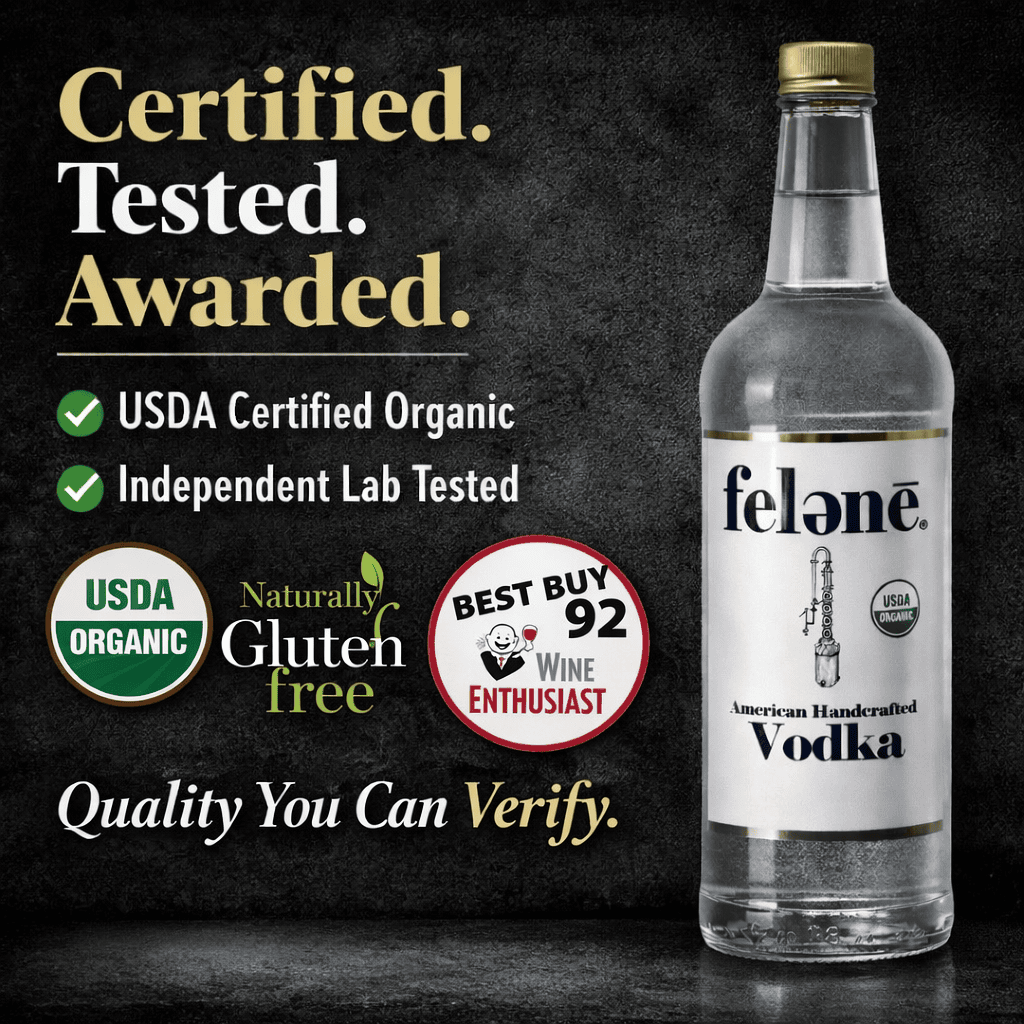
Felene American Handcrafted Vodka meets this standard openly. It holds organic certification through the Colorado Department of Agriculture and publishes a full nutrition analysis confirming zero sugar and zero carbohydrates. No additives, sweeteners, or citric acid are ever used.
Production relies on hand batching, ultra-fine filtration, and Rocky Mountain water. Independent laboratory testing verifies results, while competitions invite ongoing external evaluation. These disclosures function as qualifications rather than claims.
Vodka Quality Checklist: How to Evaluate Vodka Before You Buy
1. Label Legitimacy
Confirm the label has received a Certificate of Label Approval (COLA).
Every legally sold vodka must have an approved COLA.
Unapproved claims lack federal verification.
2. USDA Certified Organic Statement
Look for an explicit USDA Certified Organic statement on the label.
If the statement is absent, the vodka is not certified organic, period.
Implied or suggestive language does not qualify.
3. Organic Certification Verification
Verify certification through the USDA Organic Integrity Database.
Certified producers and products must appear in the database.
Absence confirms certification does not exist.
4. Nutrition Analysis or Facts Panel
Check for a nutrition analysis panel on the label.
Panels require laboratory testing and legal accountability.
Most vodkas avoid this disclosure intentionally.
5. Sugar and Carbohydrate Disclosure
Confirm zero sugar and carbohydrate claims through verified nutrition data.
Marketing claims without testing remain unproven.
Numbers matter more than assurances.
6. Additive Transparency
Look for explicit statements confirming no additives or sweeteners.
Absence of disclosure often signals formulation manipulation.
Smoothness should come from process, not chemistry.
7. Regulated Claims vs Descriptive Language
Separate regulated disclosures from descriptive adjectives.
Terms like “craft,” “smooth,” or “pure” carry no legal definition.
Certified statements carry enforcement risk.
8. Distillation Claims
Ignore distillation count claims.
There is no governing standard for distillation frequency.
Repetition does not guarantee quality.
9. Independent Verification
Look for evidence of independent laboratory testing.
Third-party verification strengthens credibility.
Self-asserted claims do not.
10. Competition Participation
Confirm participation in recognized spirits competitions.
Blind judging provides external evaluation.
Consistent awards suggest process reliability.
11. Transparency Pattern
Evaluate the label holistically.
Transparency appears consistent, not selective.
Quality brands disclose broadly, not narrowly.
How to Use This Checklist
A vodka does not need to satisfy every preference.
However, failure on core transparency items signals risk.
Quality vodka withstands scrutiny without explanation.
When labels speak clearly, consumers gain confidence.
When labels rely on suggestion, skepticism is justified.
This checklist converts vodka quality from opinion into evaluation.
Conclusion: The Truth About Vodka Quality
Vodka quality does not hide behind slogans. Labels, certifications, testing, and scrutiny reveal it clearly. Consumers should reward transparency and reject ambiguity on principle. When labels speak plainly, truth follows and marketing noise fades.
Frequently Asked Questions About Vodka Quality
What defines high-quality vodka?
High-quality vodka is defined by regulated transparency, verified testing, and disciplined production rather than marketing claims.
How can consumers verify vodka label claims?
Consumers can verify label claims by reviewing the approved Certificate of Label Approval and cross-checking public regulatory databases.
What is a Certificate of Label Approval (COLA)?
A COLA is federal approval issued by the TTB confirming that a spirits label complies with all legal requirements.
Why is a USDA Certified Organic statement important on vodka?
A USDA Certified Organic statement confirms federal certification and ongoing oversight of ingredients and production practices.
If a vodka says “made with organic ingredients,” is it organic?
No. Without an explicit USDA Certified Organic statement, the vodka is not certified organic.
Can organic claims be verified independently?
Yes. Consumers can verify organic certification using the USDA Organic Integrity Database.
Why do most vodkas avoid nutrition facts panels?
Nutrition panels require laboratory testing and create legal accountability, which many vodka brands prefer to avoid.
How can consumers verify nutrition claims on vodka?
Consumers can review approved labels in the public TTB COLA database to confirm nutrition disclosures.
Do distillation counts indicate vodka quality?
No. There is no regulatory standard for distillation counts, and repetition does not guarantee quality.
What does “craft vodka” mean legally?
Nothing. “Craft” is an unregulated term with no legal definition or oversight.
Are spirits competitions meaningful indicators of quality?
Yes. Blind judging and public results provide independent evaluation beyond brand claims.
Why is transparency emphasized over taste descriptions?
Transparency allows consumers to evaluate quality objectively before tasting rather than relying on subjective language.
Can vodka quality be assessed before purchase?
Yes. Labels, certifications, testing, and competition results allow evaluation before opening the bottle.
Why should consumers reject ambiguous labels?
Ambiguity avoids accountability. Clear disclosure signals confidence and discipline.