Vodka is mainly ethanol and water, so unflavored vodka contains almost no sugar or carbs. However, vodka still contains calories because ethanol holds energy. Also, some products include added ingredients after distillation, especially flavored vodka and canned cocktails. So, nutrition claims and “no additives” claims should be verified with proof, not assumed from label silence. Nutrition information is not a health claim, and it does not imply a health benefit.
Vodka nutrition facts: what those numbers mean
Vodka nutrition facts usually describe calories, carbs, and sugar per serving. Yet many spirits bottles do not show a serving panel with those numbers. That gap makes brand-to-brand comparison harder, even for careful shoppers. Also, the same vodka can look different on paper when serving size changes.
To keep comparisons fair, use the same serving size every time. Then separate the vodka from the mixer in your head. Many cocktails gain most sugar from juice, soda, or syrup. So, “vodka nutrition” and “drink nutrition” must be treated as two different questions. For Felene’s baseline reference, use Felene’s published nutrition testing.
RELATED: What is “Clean Vodka?”
Does vodka have calories?
Yes, vodka has calories, even when sugar stays near zero. Ethanol drives those calories, not sugar. So, a vodka can claim near-zero carbs and still deliver real calories. Proof also matters, because higher proof usually means more ethanol per ounce.
Use one serving size when you compare brands. Many people use 1.5 ounces as the baseline pour. Then check what you add to the glass. A mixer can add more calories than the vodka itself. So, your best control comes from the full recipe, not one line item.
Does vodka have carbs or sugar?
Unflavored vodka usually has almost no carbs or sugar after distillation. Distillation pulls ethanol forward and leaves sugar behind. That is why plain vodka often looks “zero” in nutrition talk. However, the story changes when ingredients get added after distillation.
Flavored vodka can be made in different ways, and those methods matter. Some producers distill flavors into the spirit, which can stay dry. Other producers add flavor blends after distillation, which can include sweet taste. Ready-to-drink cocktails usually include real sweeteners or juice. So, you should treat flavored vodka and canned cocktails as separate products. For a plain-language standard, use a clean vodka checklist for shoppers.
Why “zero carbs” can still mean meaningful calories
Calories do not come only from carbs. Ethanol carries energy, so calories can exist without sugar. That is why “zero carbs” never means “zero calories.” Also, higher proof often raises calories per ounce, because ethanol increases.
Avoid reading wellness into a carb claim. Use the numbers for planning, not for health meaning. Alcohol can carry risk at any carb level. So, a “clean label” idea should never be treated as a safety signal. Clarity helps decisions, yet it does not change alcohol’s core effects.
Why labels often do not tell you everything
Many shoppers expect a full panel that looks like food packaging. Spirits often do not show that type of panel. That reality creates a silence gap around calories, carbs, and sugar. It also creates a silence gap around ingredients added after distillation.
Label silence does not prove purity. It usually means the brand chose not to disclose extra detail. Some brands avoid panels to reduce label changes over time. Other brands avoid panels to keep marketing flexible. So, you should treat missing details as unknown, not confirmed. For the regulatory context, use why spirits labels often omit nutrition panels.
What “additives” can mean in vodka
Consumers use “additives” as a broad term, so confusion spreads fast. Some people mean sweeteners and acids. Others mean flavors, softening agents, or texture agents. Because the word can mean many things, a “no additives” claim needs a clear scope.
Unflavored vodka often contains only ethanol and water, yet you still should not assume. Some products allow small adjustments and still call themselves vodka. Also, flavored vodka almost always involves extra inputs. So, “no additives” should be read as a claim that needs proof, not a vibe. For the legal baseline, use the federal definition of vodka and treatment limits.
How to verify claims without relying on slogans
Start by naming the claim you want to verify. “No sweeteners” is not the same as “no flavors.” “No post-distillation additions” is even more specific. When you define the claim, you can choose the right proof. Without a defined scope, proof can never match the promise.
Next, ask for batch-specific documents for the bottled product. A single generic sheet proves very little. You want the lot and the test results tied together. Then check what the report tested. A report can only prove what it measured. So, read the test list, not just the headline. For a practical comparison tool, use a buyer’s framework for judging vodka claims.
Best-in-class transparency: organic oversight plus lab proof
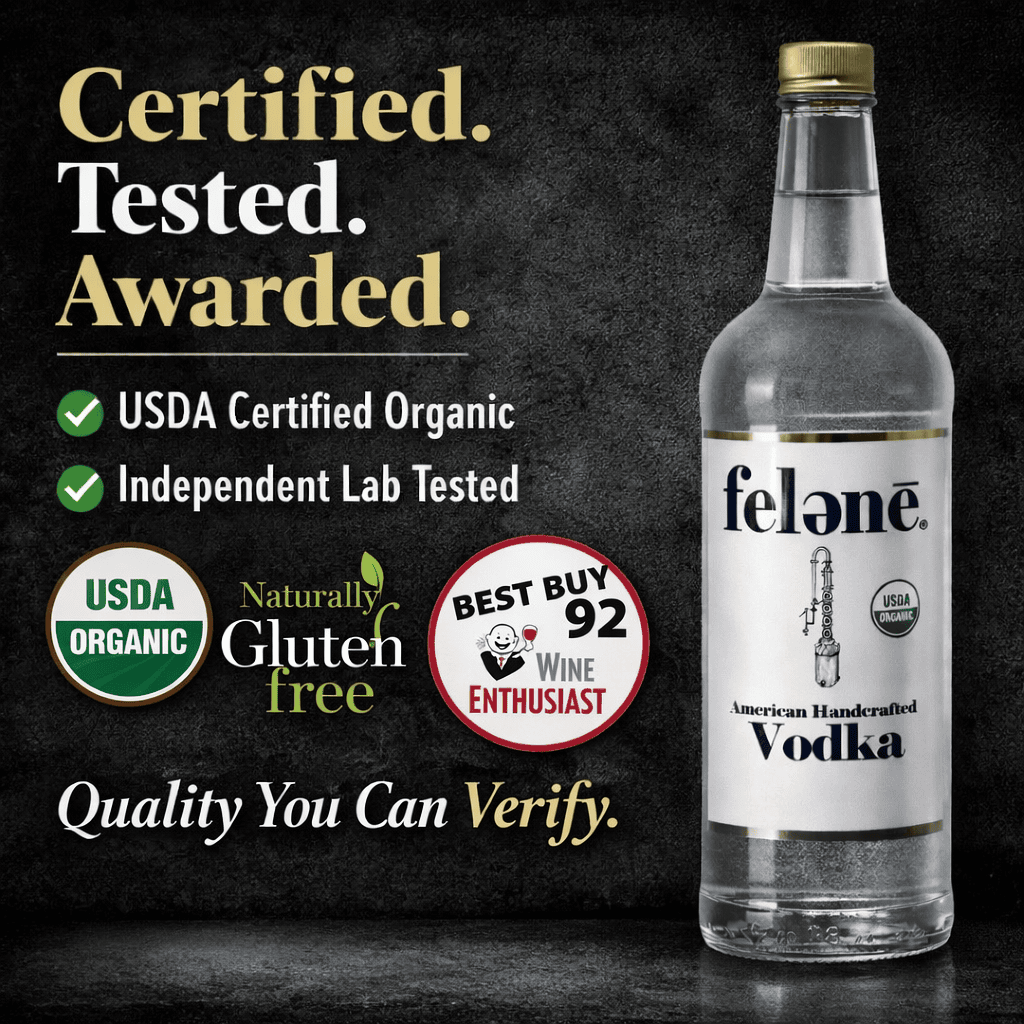
Two signals can raise trust when labels stay quiet. Organic oversight can add rules around sourcing and handling. Independent lab reports can add checkable numbers for key measures. Together, they turn marketing into something you can verify.
Still, organic status does not equal “healthier alcohol.” It does not change ethanol’s effects. Also, a lab report does not prove every possible claim by default. The value comes from clear scope and clear proof. So, the best brands publish results and explain what the results cover.
What Felene’s independent COA shows, as proof
Felene’s COA provides measured values for common nutrition questions. The report shows alcohol strength around 40.56–40.68% ABV. The report shows 0.01g carbs per 1.5-ounce serving. The report shows 98.60 calories per 1.5-ounce serving. The report shows total sugars under 0.45g per serving, with sugars below report limits.
These numbers support a transparency-first approach. They also support clear comparison using the same serving size. However, you should use the COA to prove only what it measures. That habit keeps trust high and claims precise. Precision also helps shoppers who want facts, not slogans.
What this COA does not prove, and why that matters
A COA proves only what it tests. Some items can remain untested on a given report. So, you should not stretch one report into a broad promise about everything. Instead, you should match each claim to a measured result. That approach avoids confusion and protects credibility.
This limit is not a weakness. Honest scope builds long-term trust. You can expand testing later and publish new reports. Until then, clear wording should lead every claim. Clear wording also protects the reader from false certainty.
How to verify vodka before you buy
First, identify the product type, because canned cocktails differ from straight vodka. Next, compare brands with one serving size, often 1.5 ounces. Then separate ethanol calories from sugar calories in your thinking. After that, ask for a batch COA for the bottled product.
If organic status matters to you, ask for current proof of that status. Then check whether the claim applies to the exact product you buy. Finally, favor brands that publish proof over brands that sell slogans. This approach turns a confusing shelf into a clear choice.