Best States to Start a Private Label Liquor Brand in 2026
The best states to start a private label liquor brand combine big demand with manageable operating costs. Texas, Florida, Georgia, Arizona, and Colorado often lead the list. Market scale drives faster retail wins, while lower costs protect runway. Therefore, state selection should be treated like a growth lever, not a formality.
Best States to Start a Private Label Liquor Brand: Why deep home-state penetration should come first
Many founders want a national plan on day one. However, most new operators should start in one state. A single-state launch lowers cash burn and speeds learning. Therefore, the first goal should be deep penetration in your home state.
Deep penetration means repeated wins in the same trade area. You secure shelf space, then you protect facings. Next, you build steady reorders, not one-time buys. Meanwhile, your sales story gets sharpened with each store visit. Consequently, you improve close rates and reduce wasted calls.
Costs drop when your map stays tight. Shorter drives mean more stops per day. Also, tastings become easier to staff and schedule. Storage and delivery also stay simpler with one compliance framework. Therefore, your cost per case sold can improve quickly.
Distributor attention is earned faster in one state. Depletion looks stronger when routes stay concentrated. Also, chain buyers trust a brand with local pull. On-premise accounts then reinforce the retail story through menu presence. Consequently, a following gets built where people can actually find the bottle.
Local Focus, National Aspiration
Local credibility should be treated as a growth asset. Press, awards, and retailer quotes are easier to gather locally. Social proof also spreads faster inside a tight market. Therefore, your second-state pitch becomes stronger and cheaper.
A practical rule can be used. Win 50 to 150 repeat reorder accounts in one state first. Then expand into the next state with the same playbook. This approach keeps the “Best States to Start a Private Label Liquor Brand” strategy grounded in real unit economics.
This guide targets founders hiring a contract distiller or co-packer. It also fits importers launching a U.S. label. You will see why “cheap” states can still fail you. You will also see why some expensive states still matter.
For baseline data, use U.S. Census Bureau for growth signals. Use U.S. Bureau of Economic Analysis for cost comparisons. Use Tax Foundation for broad tax climate context. Use NABCA to understand control states.
How to evaluate the best states for a private label liquor brand
The best states for a private label liquor brand deliver three advantages. You get more doors per sales mile, get faster repeat purchase patterns and get more distributor attention, because depletions show up sooner.
These factors should be used when you choose the best states to start a private label liquor brand:
- Market size and growth, led by major metros.
- Operating costs, including labor, rent, and storage.
- Business tax climate and day-to-day friction.
- Distribution reality, including chain mix and route density.
- Regulatory friction, especially control state timelines.
Excise tax affects shelf math, yet it rarely drives success alone. Instead, velocity and route density drive success. Consequently, excise tax should be treated as a pricing input.
RELATED: PRIVATE LABEL DISTILLING
Why state choice changes private label economics
Private label brands win by repeating three actions. First, you earn shelf space. Next, you drive repeat purchase. Then, you expand door count.
Large states give you more chances per sales mile. Dense metros also boost route efficiency. Therefore, one rep can cover more stores per day. That efficiency lowers your cost per case sold.
Costs matter because trade spend must stay funded. Tastings, promos, and displays cost real money. Higher rent and labor shrink your trade budget quickly. Consequently, you can lose before you learn.
Regulation also shapes timing and cash flow. Control states often move slower than license states. So, your launch plan must match the system. NABCA offers clear background on that model.
The scoring logic used here
This list weights what founders feel in the first year. It favors speed, repeatability, and clean operations.
Five factors should guide your pick:
- Market size and growth, led by big metro areas.
- Operating costs, including labor, rent, and storage.
- Tax climate for daily business operations.
- Distribution reality, including chain mix and route density.
- Regulatory friction, especially control state lead times.
Excise tax matters at the shelf, but it rarely decides success. Instead, velocity and route density decide success. Therefore, treat excise tax as a pricing input, not a strategy.
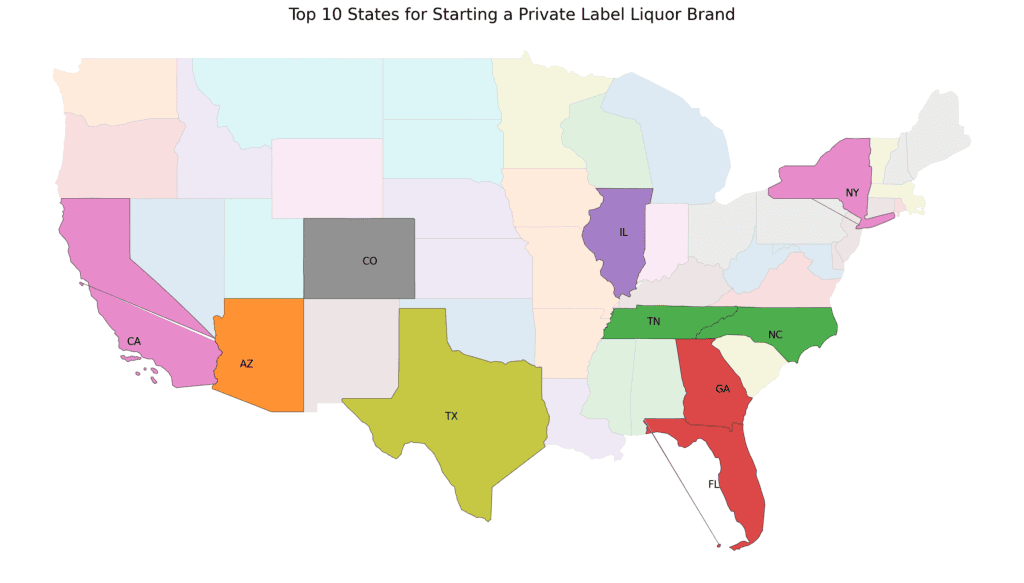
Top 10 best states to start a private label liquor brand
1) Texas
Texas offers massive scale and several launch metros. Dallas, Houston, Austin, and San Antonio each support real volume. Therefore, the best states to start a private label liquor brand often start with Texas. However, metro sequencing should be used to avoid long drives.
2) Florida
Florida supports high trial rates and steady replenishment. Tourism adds demand, and metros offer many door types. Consequently, Florida ranks among the best states for a private label liquor brand. However, seasonality should be planned into promo timing.
3) Georgia
Georgia delivers route density around Atlanta and strong suburban sales. Therefore, early sales coverage can stay efficient. The best states to start a private label liquor brand often include Georgia for this reason. Still, distributor focus should be earned with a clear pitch.
4) Arizona
Arizona provides fast-growing metro demand and strong logistics. Phoenix can support volume, while growth corridors add upside. Consequently, Arizona remains one of the best states for a private label liquor brand. However, summer strategy should be built around heat and refreshment cues.
5) Colorado
Colorado works well for fast learning and brand refinement. Consumers try new labels, and on-premise education is strong. Therefore, Colorado belongs on any list of the best states to start a private label liquor brand. Still, early focus should stay on the Front Range.
6) North Carolina as a control-state private label liquor brand play
North Carolina offers real demand, yet it operates as a control state for spirits. Therefore, timelines can stretch and paperwork matters more. The best states for a private label liquor brand can include North Carolina, but it should be treated as a program market. Consequently, it fits better after velocity is proven elsewhere.
7) Illinois
Illinois offers Chicago density and fast depletion potential. Therefore, a focused metro plan can drive quick wins. The best states to start a private label liquor brand often include Illinois for urban scale. However, costs should be modeled carefully around storage and labor.
8) Tennessee
Tennessee benefits from hospitality growth and tourism energy. Nashville supports on-premise trial, and retail follows. Consequently, Tennessee can rank among the best states for a private label liquor brand. Still, packaging must stand out in crowded sets.
9) New York
New York delivers dense accounts and strong signaling. NYC can validate premium cues quickly. Therefore, New York can be one of the best states to start a private label liquor brand for founders with budget. However, spend must be tightly controlled to protect runway.
10) California
California offers unmatched doors and trend influence. Therefore, it remains one of the best states for a private label liquor brand when supply and margins are strong. However, high operating costs punish mistakes. Consequently, many founders enter California after traction is proven.
Best states to start a private label liquor brand: control states vs license states
License states let you test faster and iterate often. Therefore, early pilots should favor license systems. Control states can still scale quickly after approval. However, they often move slower and require more planning. Consequently, the best states to start a private label liquor brand usually begin in license markets.
Best states to start a private label liquor brand: launch sequences that work
A lean sequence can reduce burn and increase learning speed. Start in Texas or Florida, then add Georgia or Arizona, then refine in Colorado. A premium sequence can start in Colorado, then scale in Texas and Florida, then signal in New York or California. A control-state sequence should prove velocity first, then add North Carolina as a program market. These sequences help you choose the best states for a private label liquor brand based on budget and risk.
Best States to Start a Private Label Liquor Brand: bottom line
The best states to start a private label liquor brand maximize selling opportunities while minimizing early cash strain. Texas and Florida usually lead for scale. Georgia, Arizona, and Colorado often lead for efficient learning. New York and California often lead for signaling, once traction is proven. North Carolina can work well, yet it should be planned like a program.
Control states vs license states
License states often let you move faster. You can test pricing and messaging quickly. Therefore, you can iterate before you scale.
Control states can offer central buying and broad reach. Yet, lead times can slow learning cycles. So, founders should enter with clean files and stable supply. NABCA remains a solid starting point.
A practical launch sequence for private label founders
Lean budget sequence
Start in Texas or Florida for scale learning. Next, add Georgia or Arizona for route density. Then, use Colorado to refine pricing and scripts.
Premium-first sequence
Start in Colorado to refine the on-premise pitch. Next, scale in Texas and Florida. Then, enter New York for signal value.
Control-state program sequence
Prove traction in a license state first. Next, build your compliance and forecast tools. Then, pursue North Carolina as a structured program.
Common mistakes that hurt founders
Many founders chase a “cheap” state with small demand. Then, reps drive too far for too few doors. Consequently, your cost per case rises.
Others start in an expensive signal state too early. Then, burn climbs before repeat purchase forms. So, learning becomes too costly.
Some teams treat control states like fast pilot markets. Then, lead times break the plan. Therefore, the budget gets stressed.
Bottom line for private label clients
Pick a state where you can learn fast and sell often. Then, scale where route density stays strong. Finally, add signal markets after you prove repeat purchase.
If you want, a state scorecard can be built for your concept. Price tier, channel mix, and budget can be baked in.